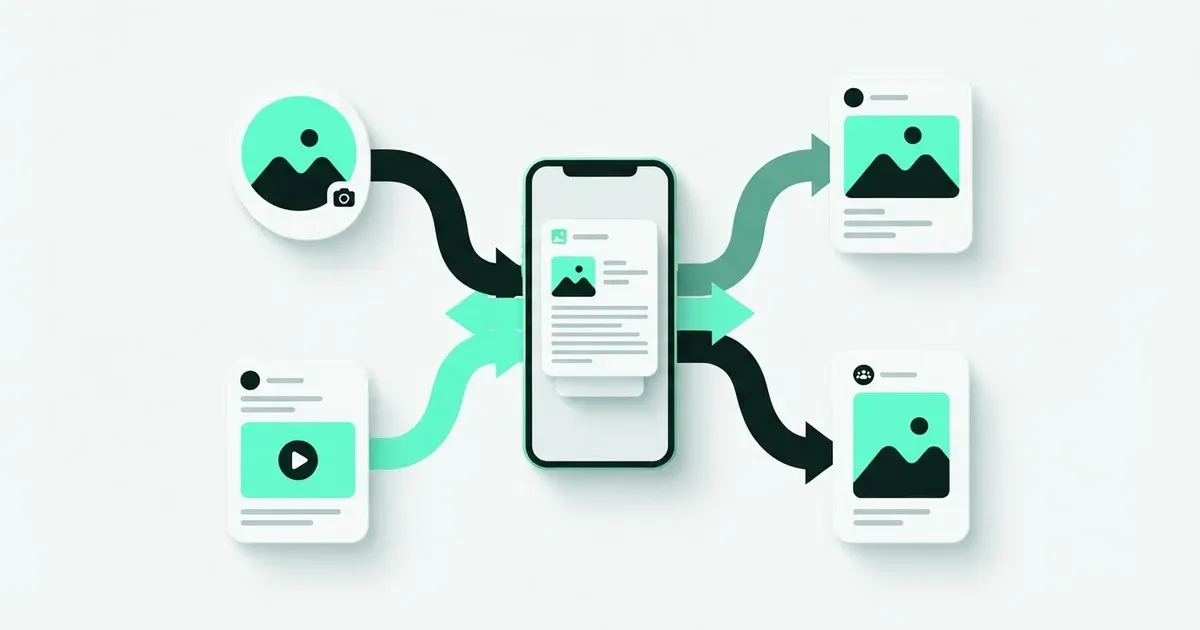
Repurposing starts with one useful idea, not one finished caption. If the source is a customer question with a clear answer, you can turn it into a short observation, a visual checklist, a demonstration, or a longer explanation. Each version should make sense on its own.
You do not need to publish on every network. “Every network” means every destination you have deliberately chosen, with a suitable format and a reason to be there. A business serving one local market may only need two versions. Producing eleven weak adaptations is a poor use of a strong source.
Build a source brief before writing versions
Keep five pieces of information together: the audience question, the answer, the evidence, the important limitation, and the desired next step. Add the owner who can confirm the facts.
For a fictional bookkeeping service, the question might be: “What should I prepare before handing over my monthly records?” The answer is a short checklist. The limitation is that requirements vary by business and adviser. The next step is to collect the documents before a meeting.
Label the example as general preparation rather than legal or tax advice. Avoid adding a universal filing rule unless you have checked it for the reader’s jurisdiction. Repurposing can multiply an error as efficiently as it multiplies a useful explanation.
Write the source in ordinary language. You can adapt a clear paragraph quickly; rewriting a vague slogan for six networks still leaves you with six vague slogans.
Identify the part that travels
Separate the central claim from its packaging. A customer quote, example screenshot, or date may depend on the original context. The method may remain useful elsewhere, but those details need fresh review.
For the records example, the transferable idea is to gather documents by a consistent category before the meeting. The source article’s introduction about the founder’s first client may not help a short-text reader.
Make an asset inventory. Do you have an approved image, a readable checklist, a demonstration recording, and permission to show the material? If you only have text, start with text destinations. Turning a paragraph into an unrelated stock-video clip adds production without necessarily adding understanding.
Give each network a job
Use a destination map like this as an editorial proposal:
| Destination | Possible version | Job |
|---|---|---|
| A short checklist carousel | Help someone save the steps | |
| A practical explanation with local context | Answer a community question | |
| A process explanation and tradeoff | Help a professional improve a workflow | |
| Threads | One observation and a specific question | Start a relevant exchange |
| X | A concise standalone lesson | Make one point quickly |
| Bluesky | A concise tip with an optional source | Contribute to a topic community |
| TikTok | A recorded demonstration | Show the task in motion |
| YouTube | A short demonstration or fuller tutorial | Explain visually at the right depth |
| A clear visual leading to a relevant resource | Make the resource easy to identify | |
| Google Business | A service-relevant update | Help someone considering the business |
| DEV Community | A technical article, if the subject fits | Explain a developer problem |
These are options, not claims that each format always performs best. A bookkeeping checklist probably does not belong on DEV Community. Leave that row unused rather than forcing the topic.
Write the short versions from scratch
Postbean enforces 280 characters for X, 300 for Bluesky, and 500 for Threads and Pinterest. Its limits for Instagram and TikTok are 2,200; LinkedIn is 3,000; YouTube is 5,000; Google Business is 1,500.
Those ceilings describe the Postbean workflow, not every native feature. A longer source should be rewritten around its central point before you approach the counter.
For example: “Before your bookkeeping meeting, collect sales records, purchase receipts, and bank statements in clearly named folders. Ask your adviser what else your business needs. Fixing the filing structure once can make the next handoff easier.”
That paragraph may still need trimming for a particular destination. Keep the qualification if it prevents an overbroad claim. Remove decoration before removing meaning.
Rebuild the visual versions
A carousel needs a sequence. Open with the task, show a short set of steps, demonstrate one example, and finish with a compact reference. Do not turn each sentence of a long article into a slide automatically.
A video needs something worth showing. Record the folder structure or demonstrate the process using fictional data. Make private information impossible to read, rather than relying on a rushed blur after recording.
For TikTok and Instagram Reels, start from a clean master file you control. Review text placement, audio rights, and the destination caption independently. A music license on one platform should not be assumed to cover another.
Postbean’s current TikTok workflow accepts video, not photo slideshows. Its carousel behavior differs by destination, so check carousels and covers before selecting every account for an image sequence.
Keep source, caption, and first comment distinct
A supporting source can belong in the caption, on a linked page, or in a first comment where that workflow is supported. Essential terms belong in the main content. A reader should not need to find a reply to learn that an offer excludes their location.
Postbean keeps a default caption and separate versions per network in its composer. Empty network versions fall back to the default. Review that fallback deliberately: an untouched short-text destination could inherit a caption that is too long.
A first comment also needs destination-specific wording. A long source list appropriate for YouTube may exceed Bluesky’s space. Keep one short explanation of what the reader will find rather than pasting an unexplained URL.
Schedule by purpose, not by copy-and-paste speed
Publish versions when they serve their audiences. A local service update may belong before customers plan their week, while a detailed professional explanation can wait for a suitable reply window.
Use per-network scheduling if the same idea needs separate times. Check the workspace time zone and dates before confirming.
For a proposed weekly workflow, draft the source Monday, prepare text versions Tuesday, create visuals Wednesday, review Thursday, and release according to the audience schedule. If the source concerns an urgent event, shorten the process while keeping fact review.
Staggering is optional. There is no universal rule that the same idea must wait a certain number of days before appearing elsewhere. The reason for spacing should be workload, audience overlap, or the campaign’s purpose.
Postbean currently connects Instagram, Facebook, LinkedIn, TikTok, YouTube, Threads, Bluesky, and DEV Community. X, Pinterest, and Google Business are marked coming soon. Any configured limits mentioned for those three are not evidence of an available connection; use native publishing or another suitable tool for them today.
A final review that catches multiplied mistakes
Read every version as if you had never seen the source. Does it identify the subject? Does it preserve the condition that made the original accurate? Does the link lead to the right language and page? Is the example still clearly hypothetical?
Check dates and numbers separately. A price correction in the source does not automatically correct a caption already copied into another draft. Assign one person to update all dependent versions.
Then inspect format compatibility, image order, cover, caption counter, selected accounts, and the scheduled time. Publish a smaller set when you cannot confidently review the whole batch.
Measure the source idea and the adaptation
Track results by both topic and destination. If the checklist succeeds on LinkedIn but struggles as a video, the subject may be sound while the demonstration needs work.
Record production minutes as well as relevant actions. Four versions taking 100 minutes may justify themselves; ten taking six hours may not. Those numbers are workload examples, not expected returns.
Keep the strongest source and revise the weak adaptation before abandoning the topic. If managing versions manually becomes repetitive, create a Postbean account and prepare one idea across your chosen destinations.