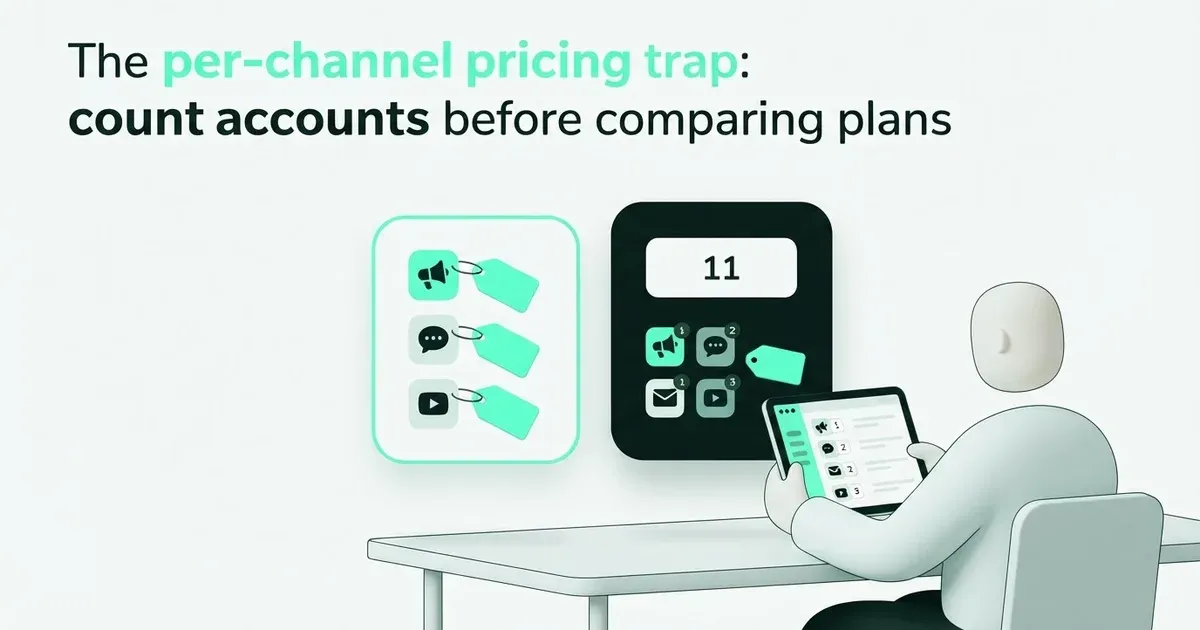
A social scheduling plan can look inexpensive until you connect the accounts you actually manage. One client may need Instagram, Facebook, LinkedIn, and Threads. If each connection is a billable unit, that client occupies four units before you add a second brand.
The mistake is comparing a price per channel with a price per bundle as if both cover the same workload. Start with an account inventory. Then compare the total you would pay today, after the next client signs, and when a client leaves.
What unhappy customers are describing
Pedro’s one-star Buffer review from November 18, 2026, describes surprise that adding Threads beside Instagram counted as another channel. Read the review.
Eva’s one-star Hootsuite review, published June 21, 2023, describes losing access to scheduled work after the free offering changed. Read the historical account. Hootsuite replied that it had notified free users through the product and email before the change. The review and reply do not establish whether that notice reached this customer.
These are different pricing complaints with a shared planning problem: the buyer’s working arrangement no longer matched the package available. Neither account proves concealed charges or establishes what every customer experiences. The older Hootsuite review also cannot tell you what a current plan includes.
Buffer’s current pricing page explicitly uses channels as its paid billing unit. That is a visible commercial choice, not evidence of deception. The practical question is whether the unit fits your account mix.
Count connections, not logos
Write down every profile or page you need to connect. Two Instagram accounts are two separate connections even though the platform logo appears once. A freelancer with one brand on five networks can have a different workload from five clients who each use one network.
Do the inventory before discussing discounts. Include accounts you keep connected for occasional seasonal campaigns. Mark any account you could disconnect without losing access you need. Ask the vendor how disconnection affects scheduled work, history, and future billing instead of assuming that it immediately reduces your bill.
Keep users separate from accounts. A client who reviews drafts is a person with access needs. Their Instagram account is a publishing destination. A plan may charge for one, both, or neither beyond an included allowance. Mixing those counts makes comparisons unreliable.
Per-channel pricing can be a good fit
If you only need a small number of destinations, paying for exactly those connections can be economical. It can also be easier to attribute a channel’s cost to a client than to divide a larger bundle across an irregular client roster.
A bundle has the opposite tradeoff. Spare capacity can make the next connection cheap to add, but you still pay for unused capacity. If you remain below a small account count for a year, the larger plan’s theoretical savings may never become real.
Use a written quote or the checkout total for your exact configuration. A starting rate is useful for finding candidates; it is a weak basis for a purchasing decision. Annual equivalents deserve their own column because the monthly-looking number may represent an upfront commitment.
Build a small growth worksheet
You do not need a complex spreadsheet. Use four rows: your current client roster, one additional client, your busiest expected month, and a quiet month after a client leaves. Put the required account count beside each row.
For illustration, imagine three clients using four accounts each. That means twelve connected accounts. If another client needs only Instagram and Facebook, the new total is fourteen. This is a hypothetical workload, not a statement about any vendor’s customers or a promise that all account types are supported.
For each candidate, record the plan required by each row and the actual billing interval. Add paid seats or other required charges only when the vendor confirms them. Treat uncertain costs as unresolved questions rather than filling them with zero.
Then calculate the difference between the quiet month and the busy month. That reveals whether the product scales smoothly with your roster or asks you to cross a larger plan boundary. Either arrangement can work if you can explain it to your clients.
Checklist before you enter payment details
Ask these questions while the trial is still running:
- What exactly counts as a channel, account, brand, social set, workspace, and user?
- Can two accounts from the same network use the included allowance?
- What is the total for my complete account inventory at checkout?
- Does annual billing charge the full year now, and what amount renews?
- What happens to the price when I add one destination midway through a period?
- Does removing a connection reduce future charges automatically or require a billing action?
- Which collaborator permissions require a different plan?
- What remains accessible if I downgrade or cancel?
- Can I keep a dated copy of the quote and cancellation confirmation?
Ask for answers in terms of your actual account list. If a product uses a bundle with one account per network, unused slots on other networks may not help you connect several accounts on the same network. Verify the composition, not just the headline total.
How Postbean packages connected accounts
Postbean uses a shared connected-account allowance across networks. Its catalog lists Free with three accounts, Starter with five at USD 5 per month, and Growth with twenty-five at USD 15 per month. The Pro catalog lists USD 39 per month and a fair-use ceiling of 1,000 accounts.
Those are monthly catalog figures. The payment provider’s product determines the actual charge, so confirm the checkout amount and interval. Do not treat a catalog value as an all-inclusive invoice or a guarantee that pricing can never change.
The allowance is a total rather than a fixed allocation of one account per platform. Postbean’s documentation explicitly allows several accounts on the same network within that limit. Twelve Instagram connections, for example, fit within Growth’s documented account allowance. You still need eligible accounts and the required permissions.
You can inspect the account-limit documentation and compare your inventory against it. If separate client environments matter, evaluate workspaces and teams independently; an account allowance alone does not prove the workspace arrangement suits your agency.
What the bundle does not solve
A bundle does not prevent your needs from outgrowing it. Moving beyond five connections changes which Postbean plan you need. Having twenty-five available slots does not make twenty-six fit. The Pro fair-use ceiling should also be described honestly rather than presented as an absence of limits.
Postbean’s connected-account packaging does not prove that it is cheaper for every buyer. A competitor may cost less for a narrow setup, or include a capability that saves you enough time to justify a higher bill. Compare the workflow you will use, including any extra tools you would otherwise keep.
Nor does a larger account allowance remove network publishing restrictions. A connected account can still need reconnection or have content rejected. Keep account capacity and publishing reliability in separate columns so one attractive number does not hide a missing operational check.
Make the bill predictable before you migrate
Choose the arrangement that stays understandable as your roster changes. If you can explain what the next client adds to the bill, you can price your own services without absorbing surprises.
Before moving scheduled work, test the required accounts and save the billing summary. Revisit the inventory when a client adds another network. That short check helps you spot a changed purchasing decision before it becomes a renewal dispute.
If Postbean’s bundles match your count, create a free account and test the account mix. If per-channel billing fits better, keep that option. The useful outcome is a total you understand, backed by a workflow you have actually tried.
Sources
- Buffer one-star review: Pedro, November 18, 2026 — checked November 22, 2026
- Buffer current pricing and billing units — checked November 22, 2026
- Hootsuite one-star review: Eva, June 21, 2023 — checked November 22, 2026
- Postbean connected-account limits and catalog prices — checked November 22, 2026